
Edit translations
Add a language, edit its storefront wording in the two-pane editor, change your English wording, and publish the result to your store.
In Settings > Translations, you edit the wording of Globo B2B Bulk Order one language at a time. This covers the Quick Order form, Collection Quick Order, Variant Table, stock labels, add-to-cart toasts and the order download in customer accounts. After you save, buyers who browse your store in that language see your wording.
Before you start
- Add the language to your store in Shopify first. In Shopify admin (not in the app), go to Settings > Languages. See Managing your store’s languages. Buyers can only switch to languages that are published there.
- To check the result, the Globo Bulk Order app embed must be on and the tool must be on a storefront page. See Enable the app embed.
- To fill in a whole language at once, use Auto-translate with AI, then review the result in this editor.
Open Translations
In Shopify admin, go to Apps > Globo B2B Bulk Order, then click Settings in the app navigation. Settings opens on Translations. From another Settings page, click Translations in the menu on the left.
The list shows every language you’ve added. English is always there.
| Column | What it shows |
|---|---|
| Language | The language name with its code, for example French fr. |
| Status | A switch: on means Published, off means Not published. |
| Actions | The pencil icon (Translate) opens the language in the editor. The trash icon (Delete) deletes it. |
Above the list, you can filter by All, Published or Not published. The search box (it reads Search forms) finds a language by name or code. The sort menu offers Newest first, Oldest first, Alphabetically A-Z and Alphabetically Z-A. The list starts sorted Alphabetically Z-A.
Add a language
-
Click Add language
At the top right of the Translations page, click Add language. The Add language window opens.
If the button is greyed out, every language in your Shopify store is already in the list.
-
Choose the language
Open the Language list (it starts at Select…) and choose a language, for example French (fr). The list shows the languages added to your store in Shopify that aren’t in the app yet, whether they’re published in Shopify or not.
-
Click Next
Click Next. The window closes and the language appears in the list with its Status switch on. The editor doesn’t open by itself: click the pencil icon in the language’s row to start translating.
Open a language in the editor
In the language’s row, click the pencil icon. The editor opens full width. Its title is the language name, for example French translation. For English, it’s English wording. To go back to the list, click Translations at the top.
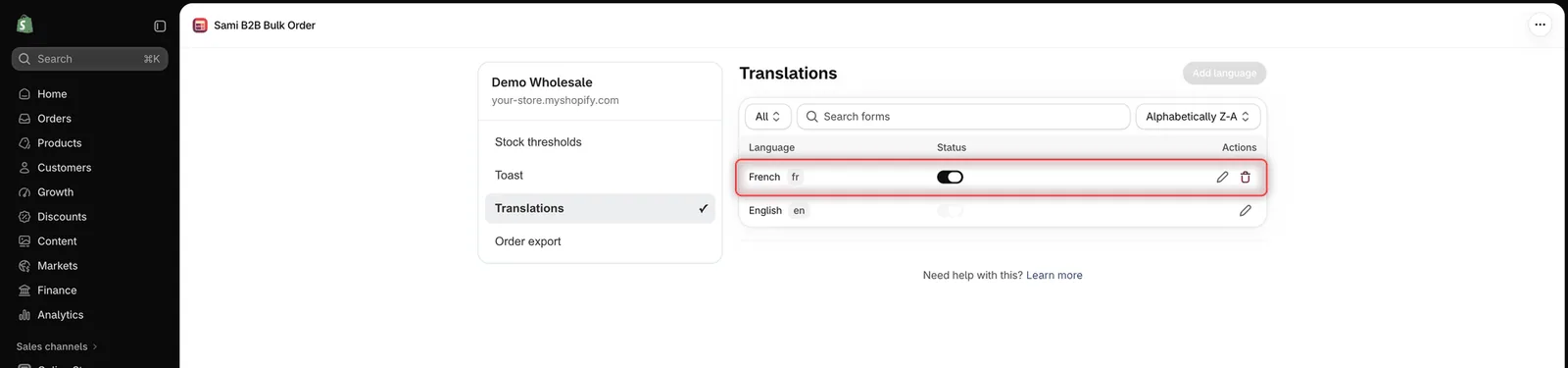
Click the pencil icon in a language's row to open it in the editor.
The editor at a glance
The editor has two panes. On the left, you choose what to work on. On the right, you edit the wording.
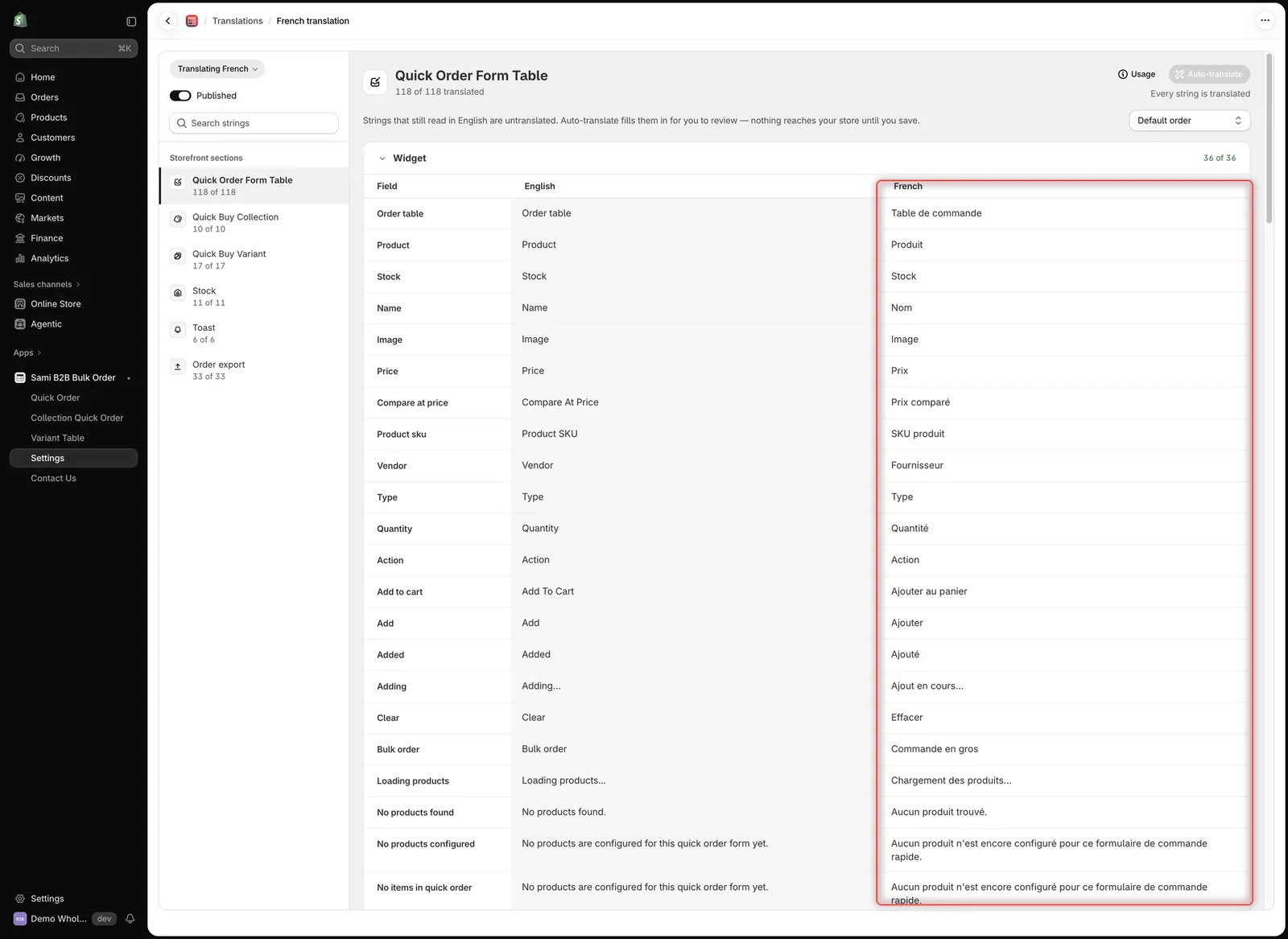
Pick a section under Storefront sections, then type the translations in the right-hand column.
Left pane, from top to bottom:
| Item | What it does |
|---|---|
| Translating French (in the English editor: Editing English) | Opens a menu of the languages you’ve added, such as French (fr), so you can switch language. |
| Published | Turns the language on or off for buyers. The change is saved when you click Save. |
| Search strings | Finds a text in all sections. It searches the English text, your translations and the field names. While you search, each section shows how many strings match, such as 3 matches, and the groups in the open section expand. |
| Storefront sections | The six sections, each with its progress: Not translated, or a count such as 20 of 118. If some translations are outdated, the count adds · 2 outdated, for example. |
The six sections and their groups:
| Section | Tool | Groups |
|---|---|---|
| Quick Order Form Table | Quick Order form | Widget, Sort and filter, File upload, Messages |
| Quick Buy Collection | Collection Quick Order | Widget, Cart widget |
| Quick Buy Variant | Variant Table | Widget, Cart widget |
| Stock | Stock labels in all three tools | Stock |
| Toast | Add-to-cart toasts | Success toast, Error toast, Accessibility |
| Order export | Order download in customer accounts | Customer account, File column headings |
Right pane, from top to bottom:
- The section name and its progress, for example 20 of 118 translated.
- Usage and Auto-translate (not in the English editor). See Auto-translate with AI.
- The note Strings that still read in English are untranslated. Auto-translate fills them in for you to review — nothing reaches your store until you save.
- Sort: Default order, Untranslated first or Translated first.
- One card per group, such as Widget, with its own count, such as 8 of 36. Click a group’s name to collapse or expand it.
Each card has three columns:
- Field: the name of the text, for example Add to cart or Pagination range, with the label Source: English.
- English: the English wording the translation is made from. If you changed the English wording, this column shows your version.
- The language name, for example French: the box you type the translation in. An empty box shows the English text in grey.
Translation status
Each string has one of three statuses. The counts in the editor are based on them.
| Status | What it means | How you see it |
|---|---|---|
| Translated | The box holds a translation that you typed or Auto-translate filled in. | It’s counted in the progress, such as 12 of 36. |
| Untranslated | The box is empty, or it still reads exactly like the English text. Every string of a new language starts as untranslated. | The box shows English text. Sort > Untranslated first puts these strings first. |
| Outdated | The string was translated, but its English wording was changed later. | An Outdated badge next to the field name, and · 1 outdated in the counts. It stays until you translate the string again. |
Translate wording
-
Choose a section
Under Storefront sections, click the section you want, for example Quick Order Form Table. To find one text, type it in Search strings, for example
View cart. If no string in the open section matches, you see No strings in this section match “{{query}}”., with your search text in place of{{query}}. -
Show what’s left first
Set Sort to Untranslated first. In each group, untranslated and outdated strings move to the top.
-
Type the translations
In the column with the language name, click the box next to the English text and type the translation. Each text is one line: pressing Enter doesn’t add a line break.
You can change several sections before you save. Your changes stay while you switch sections.
-
Save
When you change something, Shopify’s save bar appears at the top of the page. Click Save. The message Translation updated confirms it. If you see Unable to save translation, click Save again.
To undo every change since your last save, click Discard instead.
-
Check your storefront
Open your store in that language with your theme’s language selector, then reload a page that shows the tool. Your changes reach the storefront shortly after you save.
If you still see English, make sure the language is published both here and in Shopify.
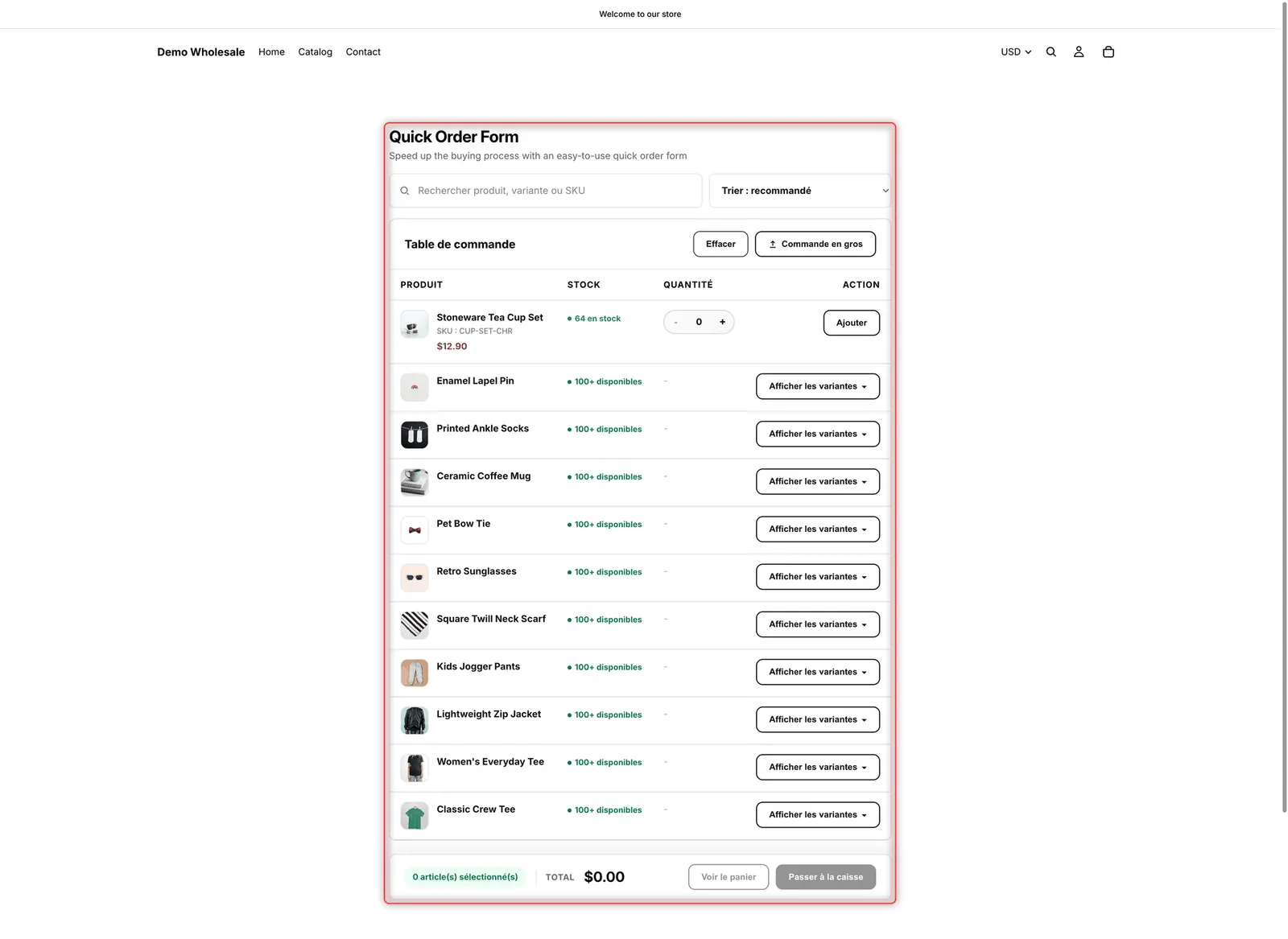
Buyers who browse your store in French see the form's wording in French.
Change your English wording
The English editor sets the wording buyers see in English. It’s also the wording every other language is translated from.
-
Open English
In the Translations list, click the pencil icon in the English row. The editor opens as English wording.
-
Edit the wording
Choose a section and type your wording in the English column. The Default column shows the app’s built-in wording for comparison.
-
Save
Click Save in the save bar. The message Translation updated confirms it.
The English editor differs from the others:
- The language button reads Editing English, and the columns are Field, Default and English.
- Section progress shows Default wording, or how many strings you changed, such as 3 changed. The pane shows, for example, 5 of 118 changed from the default. On a new store, Quick Order Form Table already shows 1 changed: your English wording says Show variants where the built-in wording says Choose variants.
- Sort offers Default order, Unchanged first and Changed first.
- The note reads The wording buyers see in English. Changing a string here marks the other languages’ translations of it as outdated.
- There’s no Usage or Auto-translate.
After you change an English string, its translations in other languages show the Outdated badge. Update them by hand, or open each language and click Auto-translate, which translates outdated strings again.
If you empty an English field, buyers see the app’s built-in English text for it.
To edit the wording of the order download, you can also go to Settings > Order export and click Edit wording. It opens this English editor at the Order export section. See Order export.
Switch to another language
Click the language button at the top of the left pane, for example Translating French, and choose another language. The language you’re editing is greyed out in the menu.
If you have unsaved changes, the window Leave without saving? opens with Your unsaved changes to this language will be lost. Click Leave to switch without saving, or Cancel to stay and save first.
Publish or unpublish a language
Buyers see a language’s wording only while it’s published. When a language isn’t published, buyers who browse in it see your English wording.
In the Translations list, click the language’s Status switch. The change is saved right away, and the message Status updated confirms it.
In the left pane of the editor, turn Published on or off, then click Save in the save bar.
Your default language is always published. Its switch is greyed out, and the editor shows Your store’s default language is always published. The default language is the language you use the app in, chosen with the language button on the Dashboard. For most stores, it’s English. See Translations.
Delete a language
- In the Translations list, click the trash icon in the language’s row.
- In the Delete window, which asks, for example, Delete French (fr)?, click Delete.
This removes all wording for that language. Buyers who browse in it then see your English wording. Your default language has no trash icon. English can’t be deleted: if you use the app in another language, English shows a trash icon, but deleting it has no effect.
Fields that don't change your storefront
A few fields are kept for older forms. In a normal setup, changing them doesn’t change what buyers see. A field marked “backup” is used only when the field named next to it is empty. Edit that field instead.
| Section › group | Field | What to know |
|---|---|---|
| Quick Order Form Table › Widget | No products found | Shown only in rare cases. The usual empty-form and no-results messages are No products configured and No products match. |
| Quick Order Form Table › Widget | No items in quick order | Backup for No products configured. |
| Quick Order Form Table › Widget | Cart total | Backup for Total. |
| Quick Order Form Table › Widget | View cart and checkout | Backup for View cart. |
| Quick Order Form Table › Widget | Check out | Backup for Checkout. |
| Quick Order Form Table › Sort and filter | Search products | Backup for Search placeholder. |
| Quick Order Form Table › Sort and filter | Hide variant | Backup for Hide variants in the Widget group. |
| Quick Order Form Table › Sort and filter | Alphabet az, Alphabet za | Backups for Name asc and Name desc. |
| Quick Order Form Table › Sort and filter | Price low to high, Price high to low | Backups for Price asc and Price desc. |
| Quick Order Form Table › Sort and filter | Search, All products, Choose variant, Stock asc | Not used. |
| Quick Buy Collection › Widget | Volume discount apply | Not used. |
| Quick Buy Collection › Cart widget and Quick Buy Variant › Cart widget | View cart and checkout | Backup for View cart and checkout in Toast › Success toast. |
| Quick Buy Variant › Widget | Volume discount apply, Msrp, Error, Sold out | Not used. |
| Quick Buy Variant › Widget | Variant, Price, Stock, Quantity, Action, Barcode | Used only for a column without a title of its own. Variant Tables you create always have column titles, saved in the app language. |
| Quick Buy Variant › Widget | In stock, Out of stock | The fields with the same names in the Stock section are used. |
| Stock › Stock | Low stock label, Last items label | Backups for Low stock legend and Last items legend. |
| Toast › Success toast | Success heading | Not shown on the storefront. Each tool’s success toast has its own heading: Added to order. in Quick Order Form Table › Messages, Added to cart successfully in Quick Buy Collection › Cart widget, and Cart updated successfully! in Quick Buy Variant › Cart widget. |
Next steps
- Auto-translate with AI
- Translations: how languages, publishing and fallback work
- Toast notifications
- Order export
Was this helpful?
Thanks for your feedback! Tell us what was missing
Report an issue